Why Compliance, Safety, and Long-Term Performance Matter More Than Price Alone
When educational institutions purchase furniture, the decision is often influenced by budget, aesthetics, timelines, and immediate operational needs[cite: 1]. While these factors are important, one critical consideration is frequently overlooked: compliance with recognized safety and performance standards[cite: 1].
In Canada, the Canadian Standards Association (CSA Group) plays a significant role in developing standards that help ensure products, environments, and systems meet established requirements for safety, accessibility, durability, and performance[cite: 1].
For schools, colleges, universities, libraries, and public institutions, understanding how standards influence furniture procurement can help decision-makers make more informed investments that support students, educators, and facility operations over the long term[cite: 1].
The reality is that educational furniture is not simply a purchase—it is part of the learning environment[cite: 1]. The quality, safety, and performance of furniture systems can influence everything from classroom functionality to accessibility, maintenance costs, and occupant well-being[cite: 1].
Before selecting desks, tables, storage systems, shelving, seating, or collaborative furniture, institutions should understand what compliance means and why it matters[cite: 1].
What Is CSA Group?
CSA Group is a standards development organization accredited by the Standards Council of Canada[cite: 1]. It develops standards and certification programs across a wide range of industries, including construction, accessibility, occupational health and safety, electrical systems, and the built environment[cite: 1].
CSA standards are developed through committees composed of subject matter experts, regulators, manufacturers, users, and industry stakeholders[cite: 1].
The goal is to establish consistent benchmarks that help improve safety, quality, and reliability[cite: 1].
For educational institutions, these standards can provide valuable guidance when evaluating furniture and interior environment products[cite: 1].
Why Standards Matter in Educational Environments
Educational facilities experience intense daily use[cite: 1].
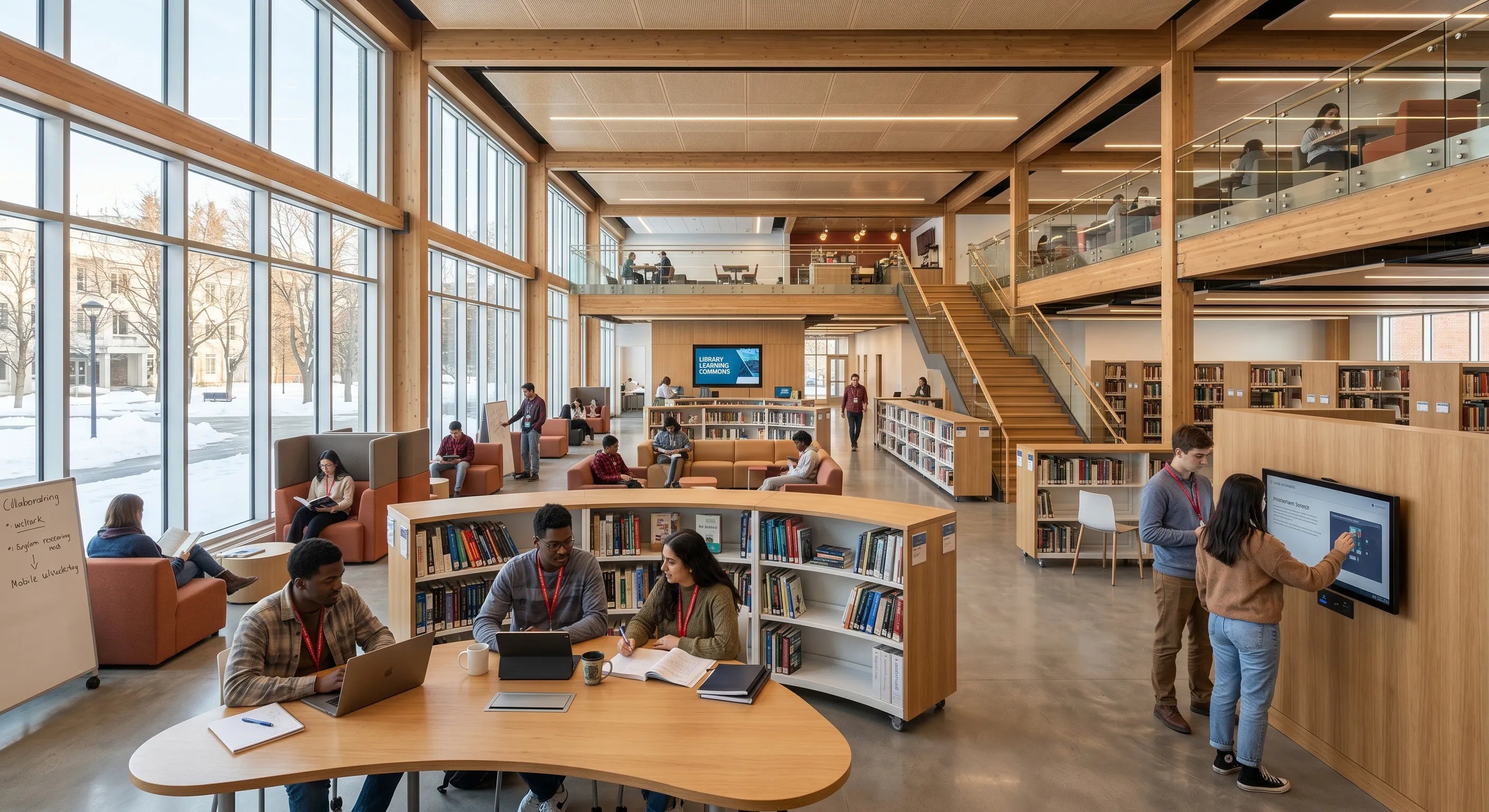
Classrooms, libraries, student commons, auditoriums, and collaborative spaces often accommodate hundreds or thousands of occupants throughout a school year[cite: 1].
Furniture used in these environments must withstand:
- Frequent movement[cite: 1]
- Continuous occupancy[cite: 1]
- Daily wear and tear[cite: 1]
- Cleaning and maintenance procedures[cite: 1]
- Changing learning configurations[cite: 1]
- Long-term operational demands[cite: 1]
Without appropriate standards, institutions may face increased maintenance costs, premature replacement cycles, safety concerns, and inconsistent performance[cite: 1].
Procurement decisions based solely on initial purchase price can sometimes result in higher lifecycle costs over time[cite: 1].
Government procurement frameworks increasingly encourage organizations to consider overall value rather than simply selecting the lowest-cost option[cite: 1].
Understanding the Difference Between Certification and Compliance
One area that often causes confusion is the distinction between certification and compliance[cite: 1].
Certification generally refers to a product being independently evaluated against a recognized standard by an accredited organization[cite: 1].
Compliance refers to meeting the requirements established by applicable standards, regulations, or specifications[cite: 1].
Not every furniture product will carry a CSA certification mark[cite: 1]. However, educational institutions should still evaluate whether products align with recognized standards for:
- Safety[cite: 1]
- Accessibility[cite: 1]
- Durability[cite: 1]
- Material performance[cite: 1]
- Structural integrity[cite: 1]
- Ergonomics[cite: 1]
The key question is not simply whether a product carries a label, but whether it has been designed and tested to perform reliably in an institutional environment[cite: 1].
Accessibility Should Be a Procurement Priority
Accessibility is one of the most important considerations when selecting educational furniture[cite: 1].
The Accessible Canada Act aims to identify, remove, and prevent barriers while promoting accessibility throughout Canadian society[cite: 1].
The CSA B651 standard, Accessible Design for the Built Environment, provides guidance that can influence educational facility planning and furniture selection[cite: 1].
When evaluating furniture, institutions should consider:
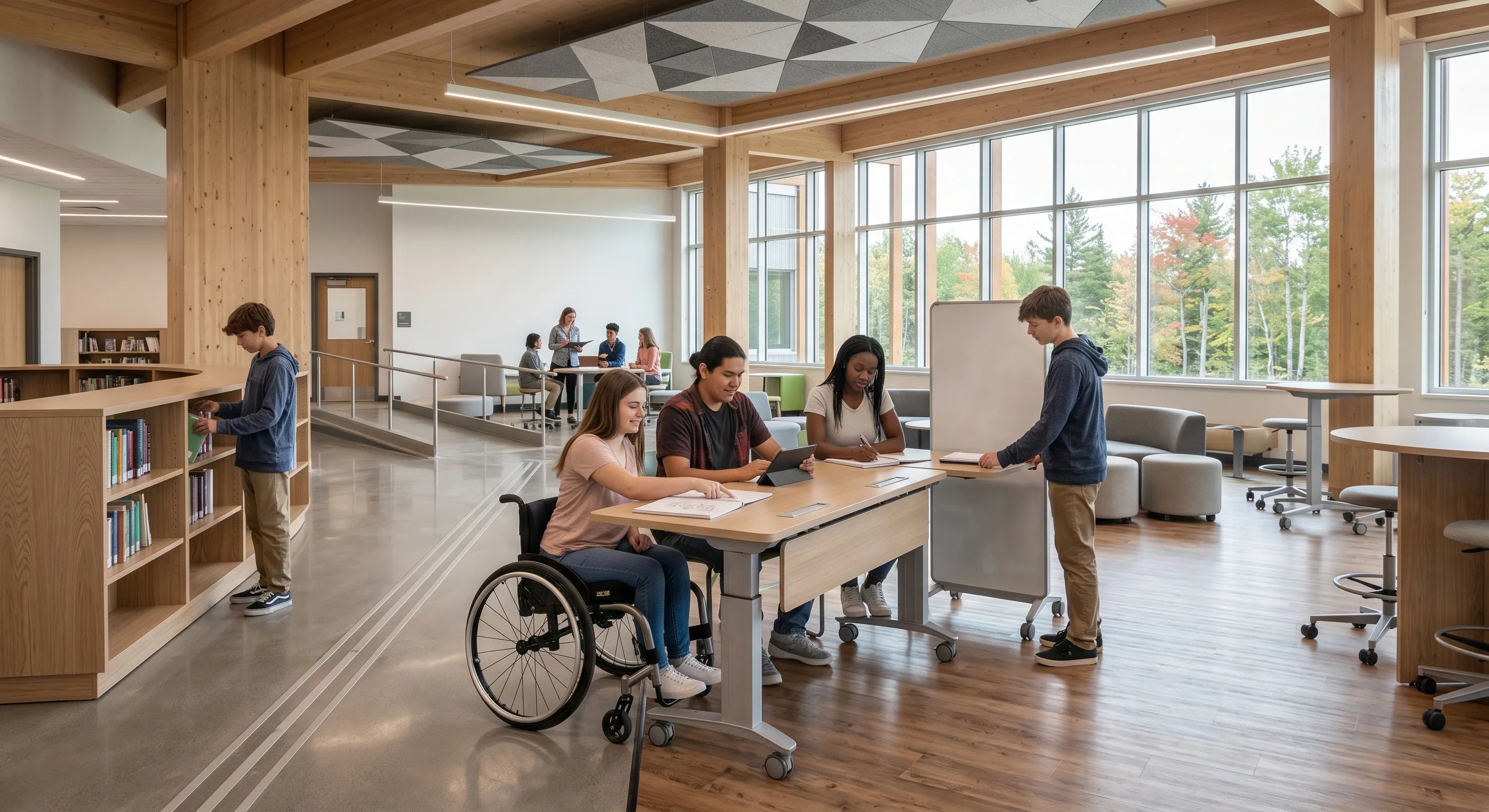
- Adjustable work surfaces[cite: 1]
- Accessible seating options[cite: 1]
- Appropriate clearances[cite: 1]
- Reachable storage systems[cite: 1]
- Flexible learning configurations[cite: 1]
- Barrier-free circulation routes[cite: 1]
Accessibility is no longer viewed as a specialized accommodation[cite: 1]. Increasingly, it is considered a core component of good educational design[cite: 1].
Durability Is a Financial Decision
Educational furniture often remains in service for many years[cite: 1].
As a result, durability should be viewed as a financial consideration as much as an operational one[cite: 1].
Questions institutions should ask include:
- How long is the expected product lifespan?[cite: 1]
- Can components be repaired or replaced?[cite: 1]
- Has the product been tested for institutional use?[cite: 1]
- How will materials perform under daily wear?[cite: 1]
- What maintenance requirements should be expected?[cite: 1]
According to Public Services and Procurement Canada, lifecycle considerations play an important role in responsible procurement decisions[cite: 1].
The lowest purchase price does not always represent the best long-term value[cite: 1].
Furniture and Student Well-Being
Furniture influences more than functionality[cite: 1].
Research increasingly suggests that physical learning environments can affect comfort, engagement, collaboration, and educational outcomes[cite: 1].
Factors such as:
- Ergonomics[cite: 1]
- Flexibility[cite: 1]
- Accessibility[cite: 1]
- Space utilization[cite: 1]
- User comfort[cite: 1]
all contribute to how effectively a space supports learning[cite: 1].
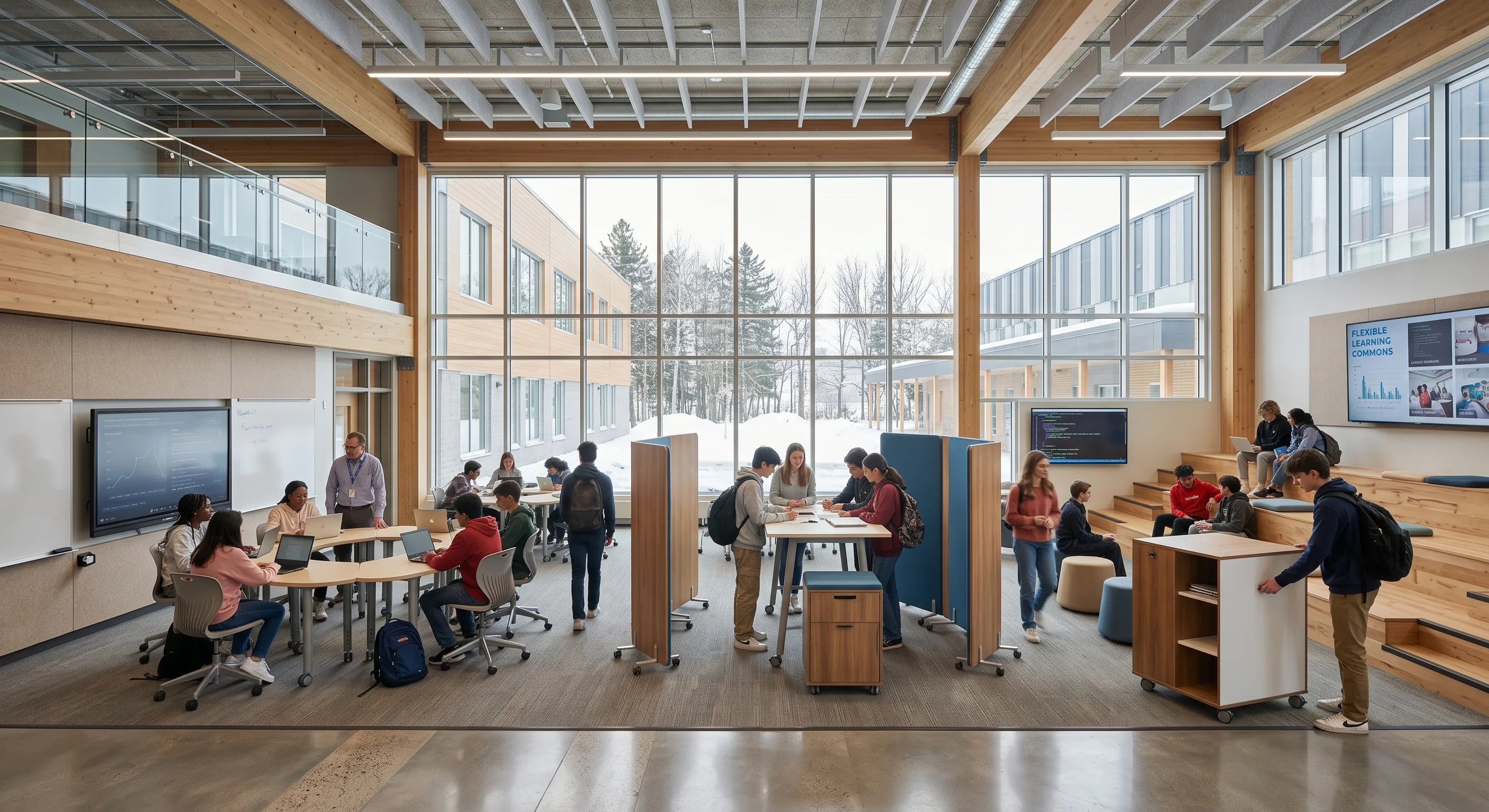
Modern educational facilities often seek furniture systems that can adapt to multiple learning modes, including individual study, group collaboration, presentations, and project-based learning[cite: 1].
The furniture itself becomes part of the educational strategy[cite: 1].
Looking Beyond Individual Products
One common procurement challenge is evaluating furniture as individual items rather than as components of a larger environment[cite: 1].
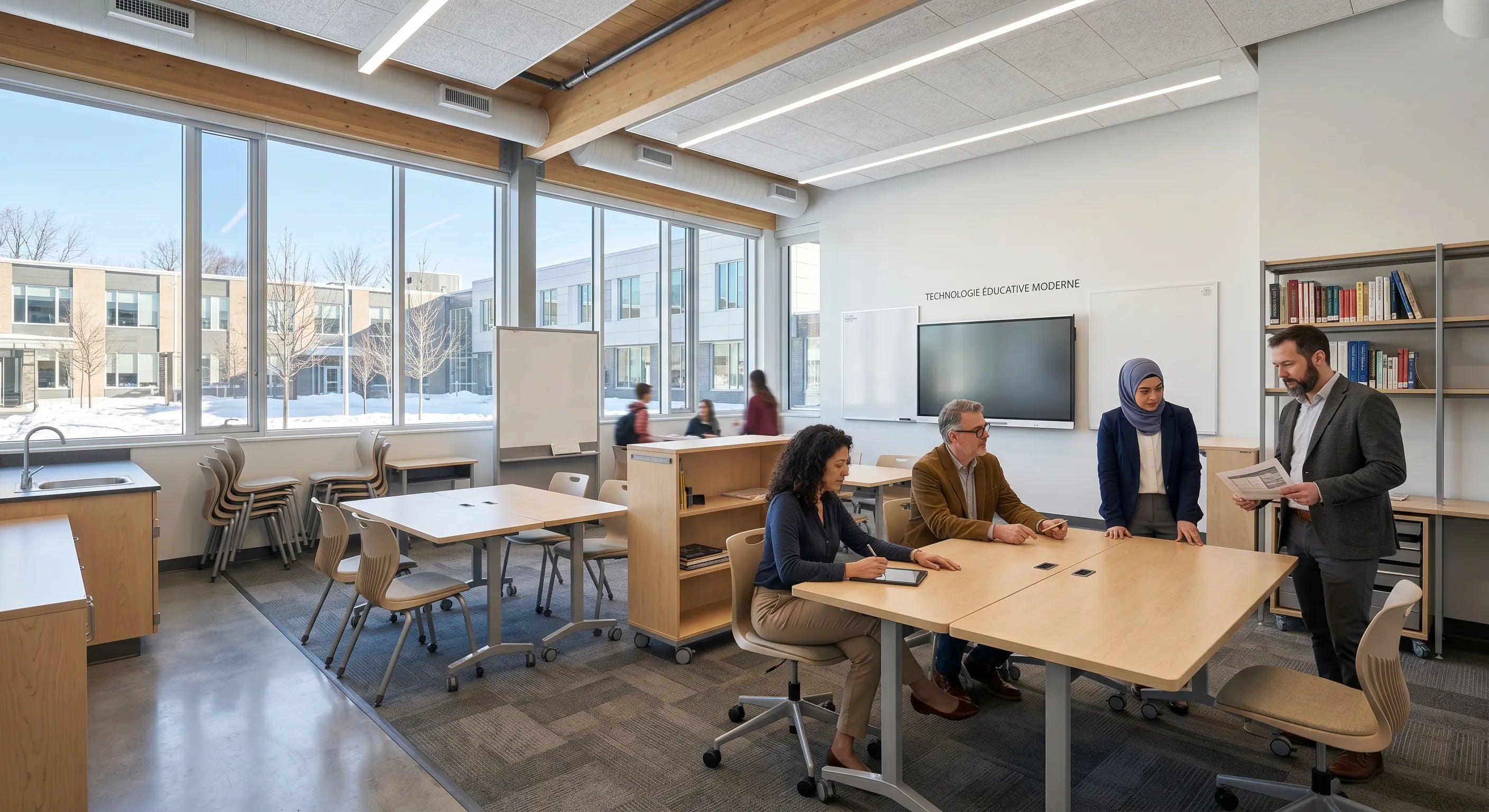
A classroom, library, or student commons functions as an interconnected system[cite: 1].
Furniture decisions influence:
- Circulation routes[cite: 1]
- Accessibility[cite: 1]
- Acoustics[cite: 1]
- Storage capacity[cite: 1]
- Collaboration opportunities[cite: 1]
- Space flexibility[cite: 1]
For this reason, many educational institutions increasingly evaluate furnishings within the broader context of educational environment planning[cite: 1].
The goal is not simply to purchase desks or storage units—it is to create environments that support learning objectives[cite: 1].
Questions Educational Institutions Should Ask Before Purchasing Furniture
Before making a procurement decision, consider the following questions[cite: 1]:
Safety & Compliance
- Does the furniture align with applicable standards?[cite: 1]
- Has it been tested for institutional use?[cite: 1]
- Does it support building and accessibility requirements?[cite: 1]
Accessibility
- Can all users comfortably access and use the furniture?[cite: 1]
- Does it support inclusive learning environments?[cite: 1]
Durability
- What is the anticipated lifespan?[cite: 1]
- How does it perform under high-traffic conditions?[cite: 1]
Flexibility
- Can spaces be easily reconfigured?[cite: 1]
- Does the furniture support multiple learning styles?[cite: 1]
Maintenance
- Are replacement parts available?[cite: 1]
- How easy is it to clean and maintain?[cite: 1]
Lifecycle Value
- What are the long-term operational costs?[cite: 1]
- Will the product remain functional as needs evolve?[cite: 1]
These questions often provide a more meaningful evaluation framework than cost alone[cite: 1].
A Holistic Approach to Educational Environments
Increasingly, educational institutions are moving beyond isolated purchasing decisions and adopting a more holistic approach to learning environments[cite: 1].
This involves considering how furniture interacts with:
- Architecture[cite: 1]
- Accessibility[cite: 1]
- Acoustics[cite: 1]
- Storage systems[cite: 1]
- Technology integration[cite: 1]
- Learning objectives[cite: 1]
Organizations specializing in educational environments often support this integrated perspective by helping institutions evaluate not only furniture selection but also how various components work together to create effective spaces[cite: 1].
For example, INSPERA's approach to educational environments reflects many of these principles through the integration of furniture systems, shelving, cabinetry, acoustic solutions, collaborative learning spaces, and turnkey interior environment planning[cite: 1]. Rather than focusing solely on products, the emphasis is placed on creating environments that support long-term functionality, compliance, and user experience[cite: 1].
This aligns closely with the broader industry trend toward evidence-based and standards-informed educational design[cite: 1].
Looking Ahead
As educational facilities continue to evolve, procurement decisions will increasingly influence the flexibility, accessibility, and performance of learning environments[cite: 1].
Understanding standards such as those developed by CSA Group can help institutions make more informed decisions while supporting safety, inclusivity, durability, and long-term value[cite: 1].
Furniture should not be viewed as a short-term purchase[cite: 1].
It should be viewed as an investment in the educational experience[cite: 1].
By prioritizing compliance, accessibility, durability, and lifecycle performance, educational institutions can create environments that continue serving students, educators, and communities for many years to come[cite: 1].
Glossary
- CSA Group: A Canadian standards development and testing organization that develops standards and certification programs across numerous industries[cite: 1].
- Compliance: The act of meeting the requirements of applicable standards, regulations, or specifications[cite: 1].
- Certification: Independent verification that a product or system has been evaluated against a recognized standard[cite: 1].
- Lifecycle Cost: The total cost associated with a product throughout its useful life, including purchase, maintenance, repair, and replacement[cite: 1].
- Accessibility: The design of products and environments so they can be used by individuals with a broad range of abilities[cite: 1].
- Institutional Furniture: Furniture specifically designed for high-use environments such as schools, colleges, universities, libraries, and public facilities[cite: 1].
- Ergonomics: The science of designing products and environments to optimize comfort, efficiency, and user well-being[cite: 1].
References
- Canadian Standards Association (CSA Group). (2023). CSA B651: Accessible design for the built environment. Retrieved from: https://www.csagroup.org/store/product/CSA%20B651
- CSA Group. (2024). About CSA Group Standards. Retrieved from: https://www.csagroup.org
- Government of Canada. (2019). Accessible Canada Act (S.C. 2019, c. 10). Retrieved from: https://laws-lois.justice.gc.ca/eng/acts/A-0.6
- Government of Canada. (2024). Public Services and Procurement Canada. Retrieved from: https://www.canada.ca/en/public-services-procurement.html
- Standards Council of Canada. (2024). National Standards System. Retrieved from: https://www.scc.ca
- Treasury Board of Canada Secretariat. (2024). Directive on the Management of Procurement. Retrieved from: https://www.tbs-sct.canada.ca/pol/doc-eng.aspx?id=32694
- Organisation for Economic Co-operation and Development (OECD). (2017). The OECD handbook for innovative learning environments. Retrieved from: https://www.oecd.org/education/the-oecd-handbook-for-innovative-learning-environments-9789264277274-en.htm
- National Research Council Canada. (2024). Codes Canada Resource Centre. Retrieved from: https://codes-guides.nrc-cnrc.gc.ca
- Infrastructure Canada. (2023). Community and infrastructure planning resources. Retrieved from: https://www.infrastructure.gc.ca