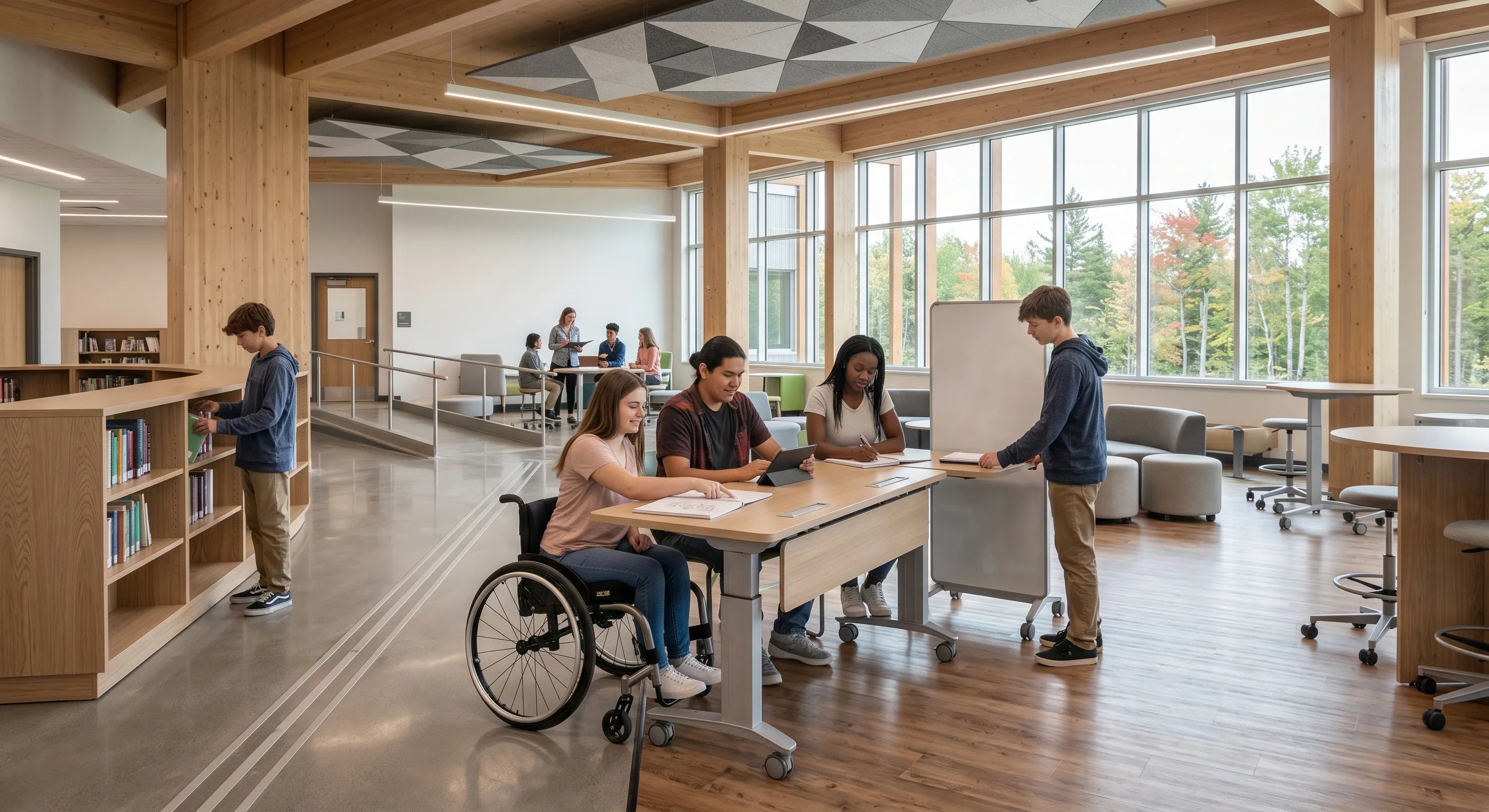
Creating Educational Environments That Support Every Learner
Accessibility is no longer viewed as a specialized design consideration reserved for a small portion of the population. Across Canada, accessibility has become a fundamental principle of educational planning, reflecting a broader commitment to inclusion, equity, and participation.
Schools, colleges, universities, libraries, and learning centres are expected to provide environments that enable all individuals—including those with mobility, sensory, cognitive, and temporary disabilities—to navigate, learn, collaborate, and thrive independently.
While accessibility is often associated with ramps and elevators, truly accessible learning environments extend much further. Classroom layouts, furniture selection, storage systems, circulation routes, acoustics, wayfinding, and collaborative spaces all play a role in creating educational environments that support diverse needs.
As educational institutions modernize their facilities, understanding accessibility requirements and best practices has become increasingly important—not only for compliance, but also for creating better learning experiences for everyone.
Understanding Accessibility in Canada
Canada has made significant strides toward creating a more accessible society through legislation, standards, and design guidance.
One of the most significant developments was the introduction of the Accessible Canada Act (ACA), which came into force in 2019. The Act aims to identify, remove, and prevent barriers in areas under federal jurisdiction while promoting a barrier-free Canada by 2040 (Government of Canada, 2019).
In addition to federal legislation, educational facilities often reference:
- Provincial accessibility legislation
- Building code requirements
- CSA accessibility standards
- Universal design principles
- Institutional accessibility policies
The CSA B651 standard, Accessible Design for the Built Environment, is widely recognized as a leading resource for creating accessible spaces in Canada (CSA Group, 2023).
Together, these frameworks help guide the development of educational environments that can accommodate a wide range of users.
Accessibility Benefits Everyone
One common misconception is that accessibility only benefits individuals with permanent disabilities.
In reality, accessible design improves usability for many people, including:
- Students using mobility devices
- Individuals recovering from injuries
- Older adults
- People with visual impairments
- Individuals with hearing challenges
- Students with neurodiverse learning needs
- Parents with strollers
- Visitors carrying equipment or supplies
This broader perspective aligns with the concept of Universal Design, which encourages environments that can be used by as many people as possible without requiring adaptation or specialized design (Centre for Excellence in Universal Design, 2024).
When learning environments are designed for inclusivity from the outset, they often become more comfortable, intuitive, and effective for all users.
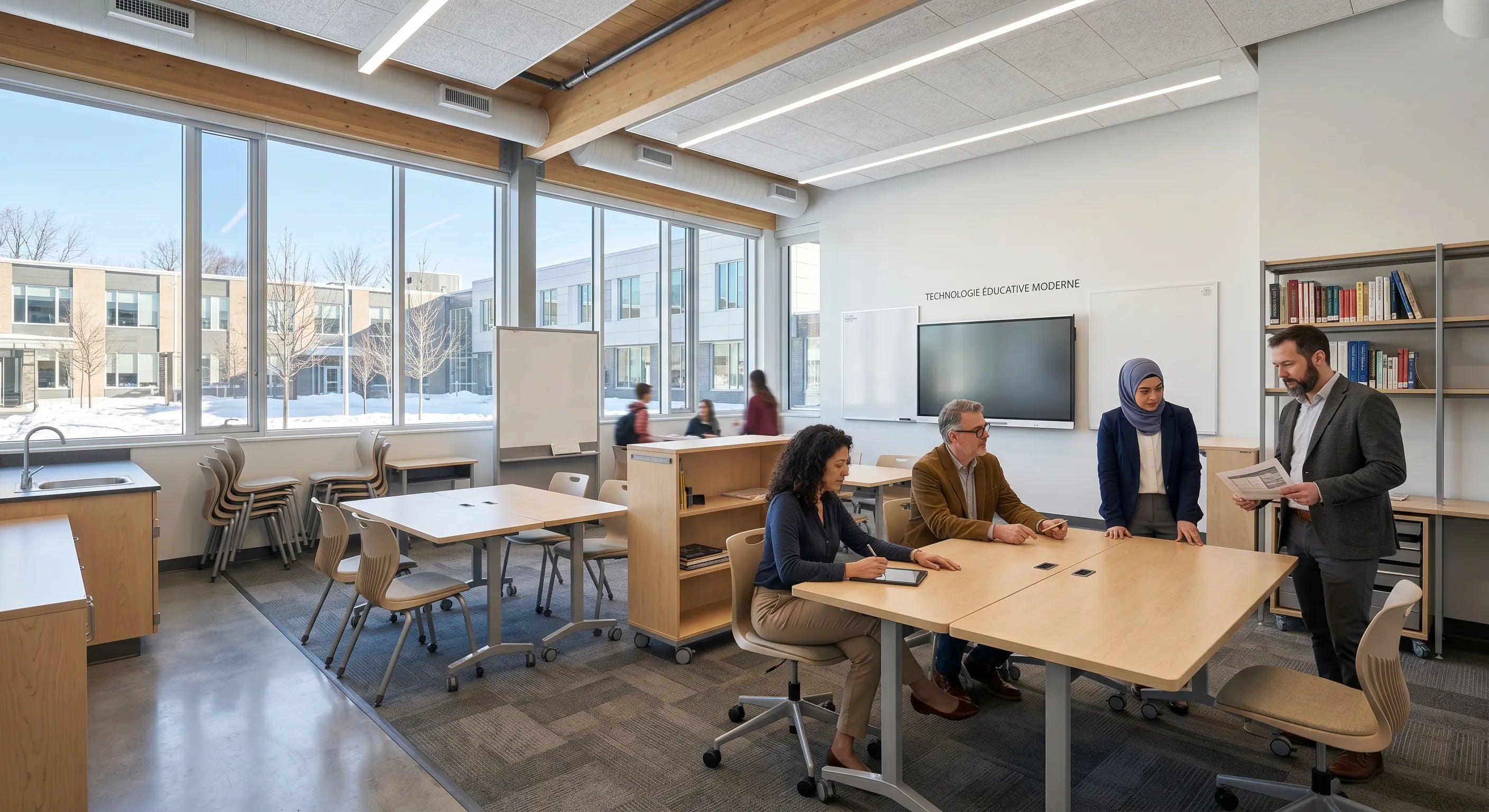
Classroom Layouts and Accessible Learning
The classroom remains the foundation of most educational facilities, making accessibility considerations particularly important.
Accessible classrooms should support:
- Clear circulation routes
- Flexible furniture arrangements
- Accessible seating options
- Visual access to instructional materials
- Inclusive participation opportunities
According to CSA B651, adequate maneuvering space is necessary for individuals using mobility aids to move comfortably throughout a room (CSA Group, 2023).
This means that classroom layouts should consider:
- Aisle widths
- Turning clearances
- Furniture spacing
- Entry and exit pathways
Flexible layouts can also help accommodate changing classroom needs while maintaining accessibility.
Rather than treating accessibility as an afterthought, many modern educational facilities integrate accessibility directly into their classroom planning strategies.
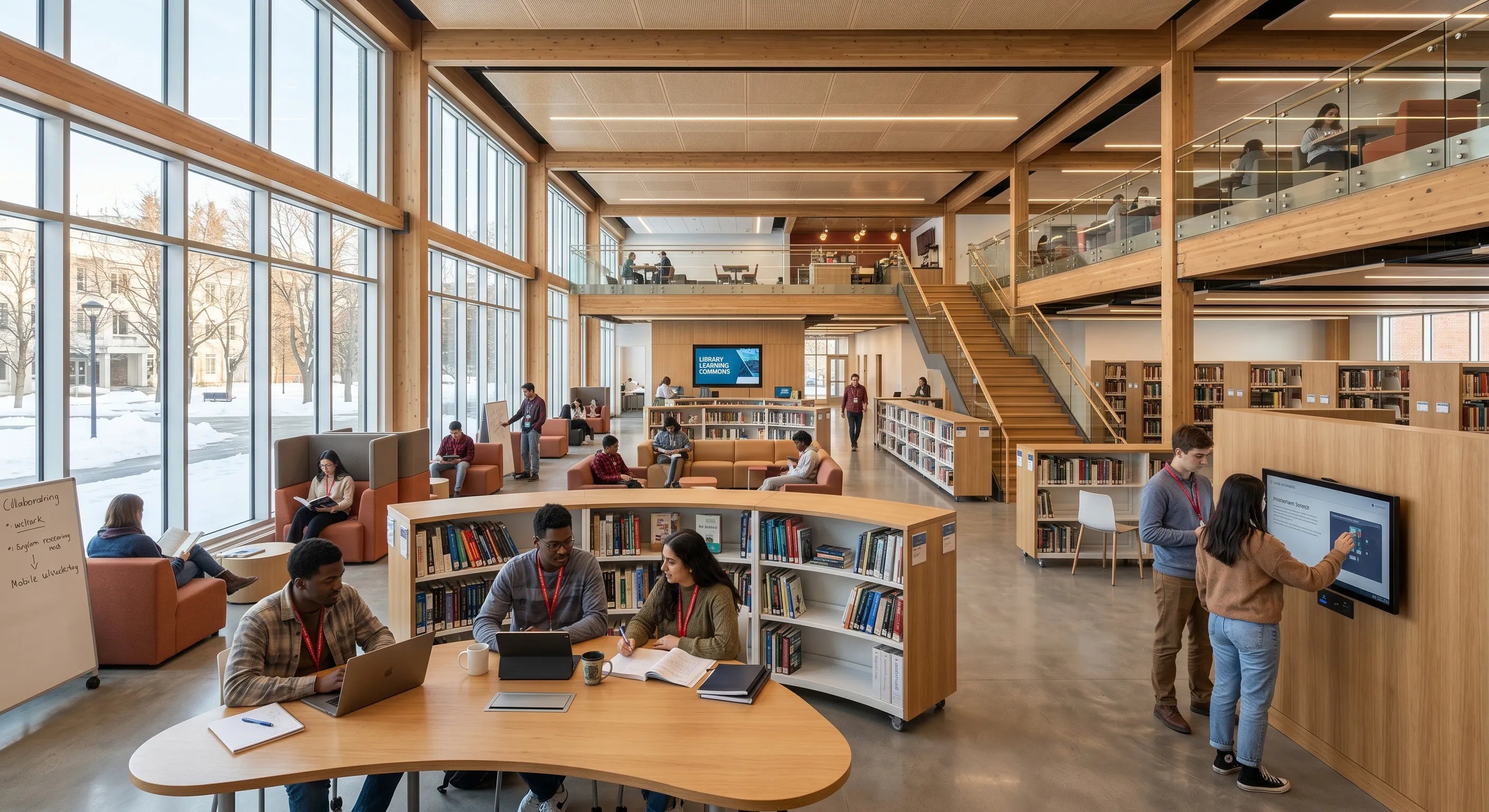
Libraries and Learning Commons
Libraries have evolved from quiet book repositories into dynamic learning hubs that support research, collaboration, technology integration, and independent study.
These evolving functions create new accessibility considerations.
Accessible library environments may include:
- Reachable shelving systems
- Clear circulation pathways
- Accessible study stations
- Flexible seating options
- Visual wayfinding systems
- Quiet spaces for focused learning
The goal is to ensure that all users can independently access resources and participate in educational activities.
When planning libraries and learning commons, accessibility should be considered alongside acoustics, furniture systems, storage solutions, and technology integration.
Furniture Selection Matters
Furniture is often one of the most visible—and influential—components of an educational environment.
Accessible furniture considerations may include:
- Adjustable-height desks
- Flexible seating solutions
- Appropriate knee clearance
- Reachable work surfaces
- Stable and durable construction
- Adaptable learning configurations
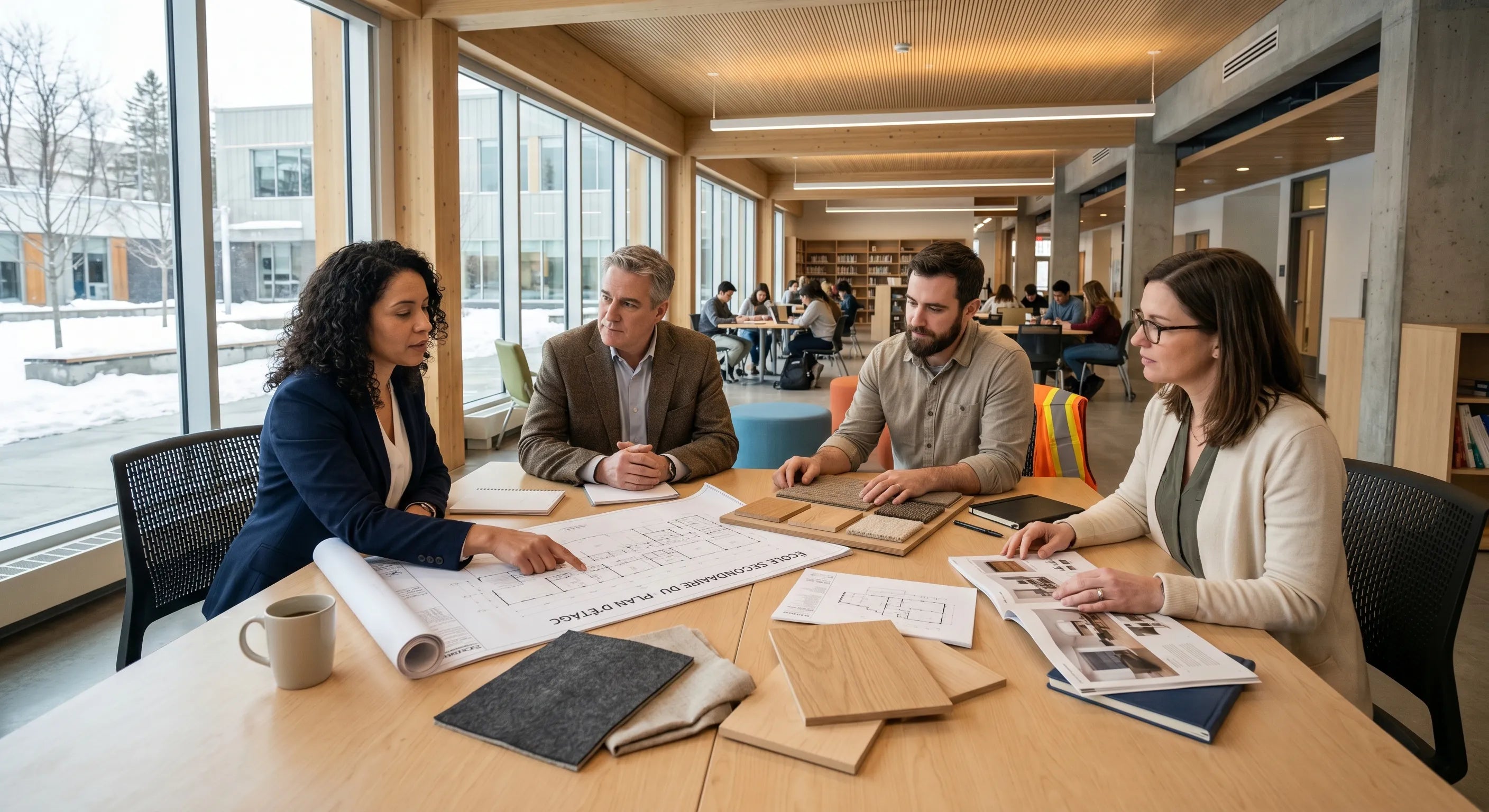
Educational institutions increasingly recognize that furniture is not merely a procurement item—it directly influences how people interact with a space.
Thoughtful furniture planning can help support inclusion while also improving flexibility and long-term functionality.
Organizations involved in educational environments, including companies such as INSPERA, often approach furniture systems as part of a broader strategy that considers accessibility, circulation, collaboration, and user experience within learning spaces.
Pathways and Circulation Routes
Accessibility depends heavily on movement.
Even well-designed spaces can become difficult to navigate if circulation routes are obstructed or poorly planned.
Accessible pathways should support:
- Smooth travel throughout the facility
- Clear access to classrooms
- Entry into common spaces
- Access to libraries and learning commons
- Emergency egress
Furniture placement, shelving systems, storage cabinets, and collaborative zones should be planned carefully to ensure that movement remains intuitive and barrier-free.
In educational environments, circulation design often influences both safety and usability.
Storage Systems and Accessibility
Storage solutions play a larger role in accessibility than many people realize.
Cabinetry, shelving systems, lockers, and storage units should be designed with accessibility in mind.
Important considerations include:
- Reach ranges
- Operable hardware
- Visibility of contents
- Ease of use
- Accessible placement
Storage systems that are difficult to reach or operate can unintentionally create barriers for students and staff.
Thoughtful storage design helps ensure that resources remain available to all users.
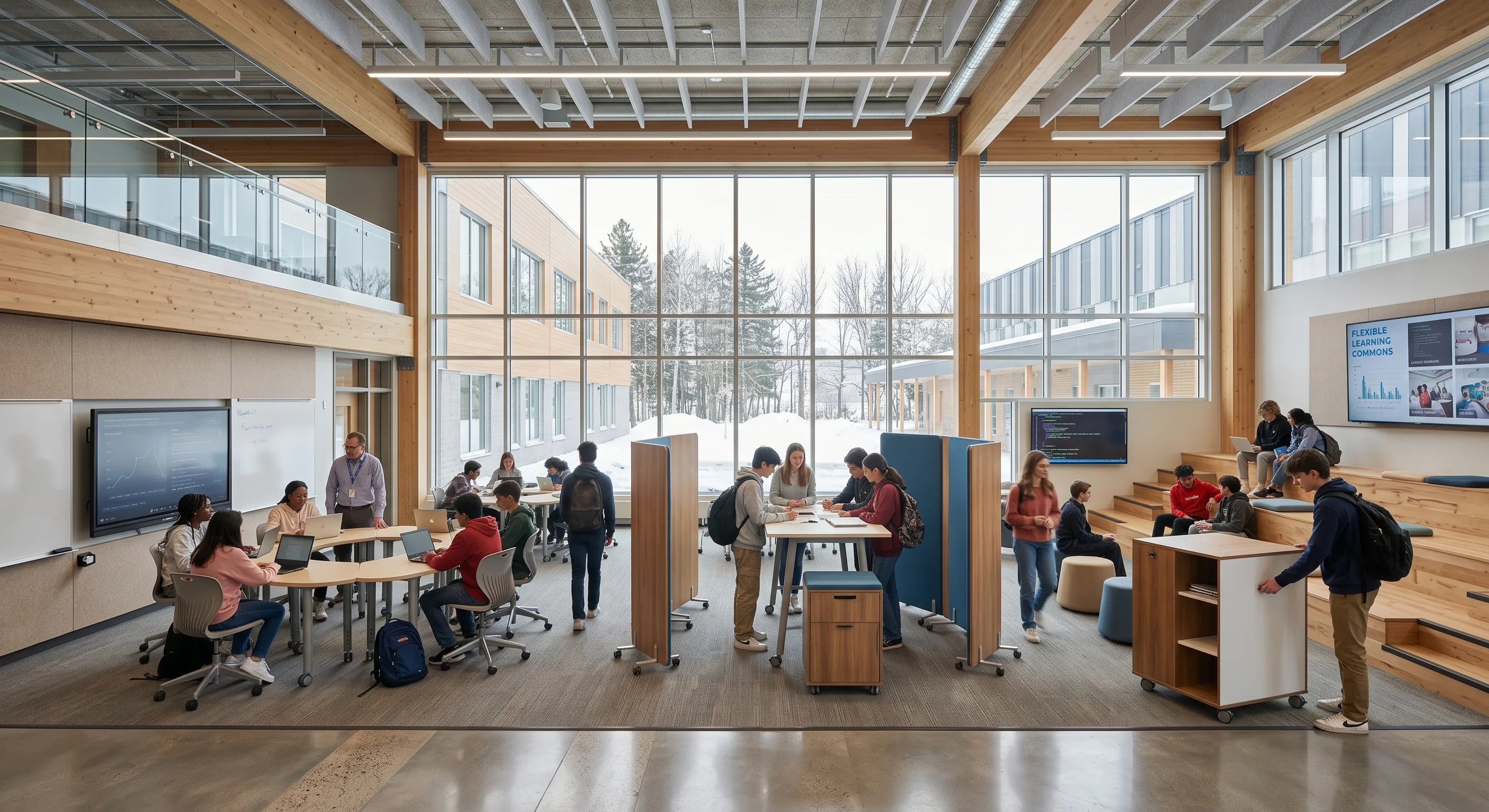
Common Areas and Shared Spaces
Educational facilities increasingly incorporate shared environments such as:
- Student commons
- Collaboration zones
- Cafeterias
- Multipurpose spaces
- Administrative areas
- Study lounges
These spaces often accommodate a wide range of activities and user needs.
Accessibility in common areas may involve:
- Flexible furniture arrangements
- Accessible seating locations
- Clear pathways
- Visual and tactile wayfinding
- Appropriate acoustics
- Inclusive gathering spaces
Creating welcoming common areas can help foster a stronger sense of belonging and participation within educational communities.
Acoustics and Sensory Accessibility
Accessibility extends beyond physical mobility.
Many students benefit from environments that support sensory comfort and communication.
Research from the National Research Council Canada has shown that acoustics can significantly influence speech intelligibility and learning outcomes within classrooms (Yang & Bradley, 2009).
Poor acoustic conditions may create barriers for:
- Students with hearing impairments
- English and French language learners
- Neurodiverse learners
- Younger students
Acoustic wall panels, ceiling treatments, privacy dividers, and sound-absorbing materials can contribute to more accessible learning environments by supporting clearer communication and reducing sensory distractions.
Accessibility as a Long-Term Investment
Educational institutions face increasing pressure to create spaces that remain functional and inclusive for decades.
Accessibility should therefore be viewed as a long-term investment rather than a compliance exercise.
Benefits may include:
- Improved user experience
- Greater inclusivity
- Enhanced participation
- Better learning outcomes
- Increased facility flexibility
- Reduced future renovation costs
Facilities designed with accessibility in mind are often better equipped to adapt to changing educational needs over time.
Looking Ahead
The future of educational design is inclusive.
As schools, colleges, and universities continue to evolve, accessibility will remain a critical component of creating spaces that support learning, participation, and community engagement.
The most successful educational environments recognize that accessibility is not a separate feature—it is an integral part of good design.
By considering classroom layouts, libraries, furniture systems, pathways, storage solutions, common areas, and acoustics together, institutions can create learning environments that support every learner.
When accessibility is thoughtfully integrated into educational spaces, everyone benefits.
Glossary
- Accessible Canada Act (ACA): Federal legislation enacted in 2019 with the goal of creating a barrier-free Canada through the identification, removal, and prevention of barriers.
- Universal Design: A design approach that seeks to create environments usable by the widest range of people without requiring adaptation.
- CSA B651: A Canadian standard that provides guidance for accessible design in the built environment.
- Learning Commons: A flexible educational environment designed to support collaboration, independent learning, research, and community engagement.
- Circulation Route: A pathway used by occupants to move throughout a facility.
- Reach Range: The accessible area within which a person can comfortably reach and use equipment, controls, or storage systems.
- Speech Intelligibility: The ability to accurately hear and understand spoken communication within a space.
References
- Canadian Standards Association (CSA Group). (2023). CSA B651: Accessible design for the built environment. Retrieved from: https://www.csagroup.org/store/product/CSA%20B651
- Centre for Excellence in Universal Design. (2024). The 7 Principles of Universal Design. Retrieved from: https://universaldesign.ie/about-universal-design/the-7-principles
- Government of Canada. (2019). Accessible Canada Act (S.C. 2019, c. 10). Retrieved from: https://laws-lois.justice.gc.ca/eng/acts/A-0.6
- Government of Canada. (2024). Accessibility Standards Canada. Retrieved from: https://accessible.canada.ca
- Government of Québec. (2024). Office des personnes handicapées du Québec (OPHQ). Retrieved from: https://www.ophq.gouv.qc.ca
- Government of Québec. (2024). Accessibility and Inclusion Resources. Retrieved from: https://www.quebec.ca
- National Research Council Canada. (2020). National Building Code of Canada 2020. Retrieved from: https://nrc.canada.ca/en/certifications-evaluations-standards/codes-canada/publications-codes-canada/national-building-code-canada-2020
- National Research Council Canada. (2024). Codes Canada Resource Centre. Retrieved from: https://codes-guides.nrc-cnrc.gc.ca
- Yang, W., & Bradley, J. S. (2009). Effects of room acoustics on the intelligibility of speech in classrooms. National Research Council Canada. Retrieved from: https://publications-cnrc.canada.ca/eng/view/object/?id=223617b1-bcd3-4df3-aa20-e044b4c43f9c